Unlock the Full Potential of Evidence Generation in Rare Disease Studies
Real-world data (RWD) and real-world evidence (RWE) are emerging as strategic tools to address research challenges with patient-centric, real-world solutions.
Despite progress, 95% of rare diseases do not have disease-specific therapy (1). The unique complexities of rare disease research—including small, dispersed patient populations and ethical challenges with traditional trial designs—create significant hurdles for drug development. To overcome these barriers, the industry must implement modern study designs and strategically incorporate patient-centric approaches.
Your Guide to Modern Study Design
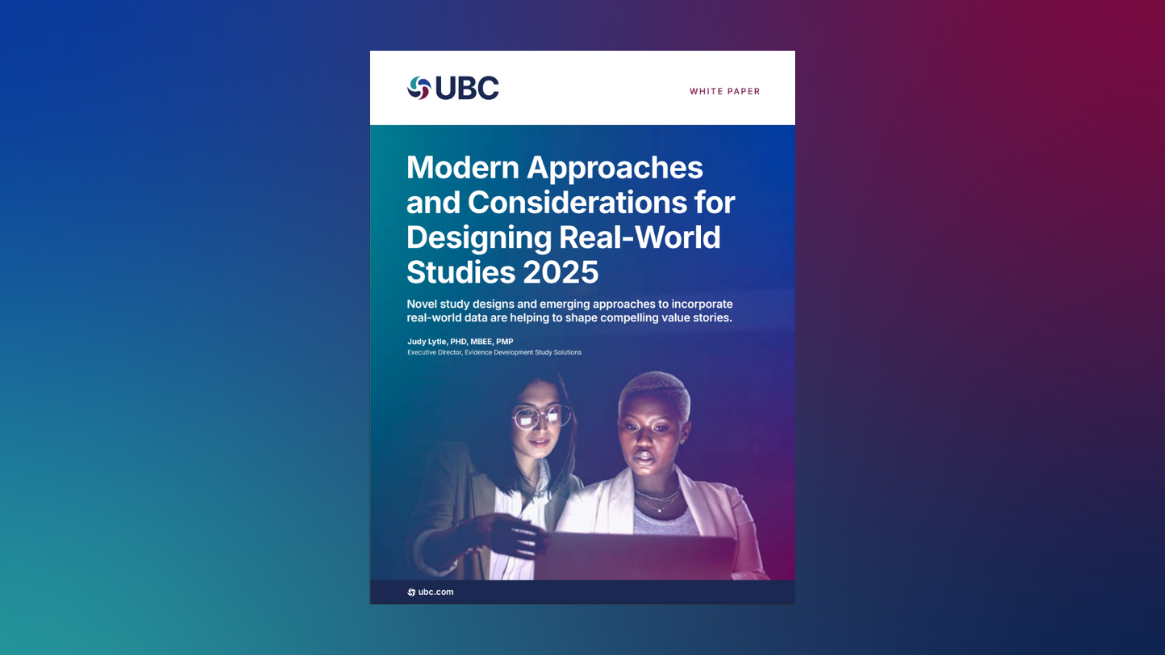
Our white paper, Optimizing Evidence Generation in Rare Disease Studies with Patient-Centric Strategies, explores how RWD and RWE can be leveraged as strategic tools from the earliest stages of product development.
The white paper details modern study designs and the essential use of RWD/RWE for:
Demonstrating value support regulatory decision-making
Planning your RWE strategy
The Value of Early Planning
Success in rare disease research hinges on strategic foresight—a principle emphasized by UBC’s leading experts. The paper features critical insights from Executive Director of Real-World Study Solutions Judy Lytle and Executive Director of Clinical Research Bruce Smith, who discuss how early strategic planning of evidence generation is pivotal for rare disease studies.
Transform Your Evidence Strategy
Download the paper to learn how a patient-centric RWE approach can:
Solve Recruitment Challenges
Leverage RWD (including claims databases) and advocacy group collaboration to identify and engage hard-to-find patient cohorts.
Minimize Patient Burden
Utilize decentralized study elements (e.g., remote monitoring, in-home nursing, telehealth) to dramatically expand the addressable patient population beyond geographic limits.
Accelerate Regulatory Pathways
Understand how RWE is increasingly used to support regulatory decision-making, including supporting safety and efficacy, particularly through the use of external controls in single-arm trials.
Build Foundational Knowledge
Learn how RWD informs natural history studies, helping to define disease progression, treatment guidelines, and appropriate clinical outcome assessments.
Don’t Let Rare Disease Challenges Stall Your Progress
Download the white paper now to gain UBC’s expert strategies on RWD/RWE and ensure early strategic planning is your key to study success.
Read UBC’s white paper for how PV data management practices can adapt to an evolving data landscape while maintaining adherence to rigid regulatory reporting and data quality standards.
Bekki Bracken Brown serves as the President and CEO of UBC, guiding the company’s mission and values, including the improvement of access for patients to receive better outcomes. She oversees all aspects of UBC, such as operations, business growth strategy, sales and marketing, and acquisition support.
With over 20 years of industry experience, Ms. Brown brings knowledge from a successful career in senior management from her tenure at Quintiles, INC Research, and, most recently, with Syneos Health. She’s been a member of the North Carolina BIO Board of Directors since 2019. She is also a member of the Healthcare Businesswomen’s Association — Southeast Chapter and CHIEF, an organization that supports women executive leaders. Ms. Brown earned her bachelor’s degree at Duke University.