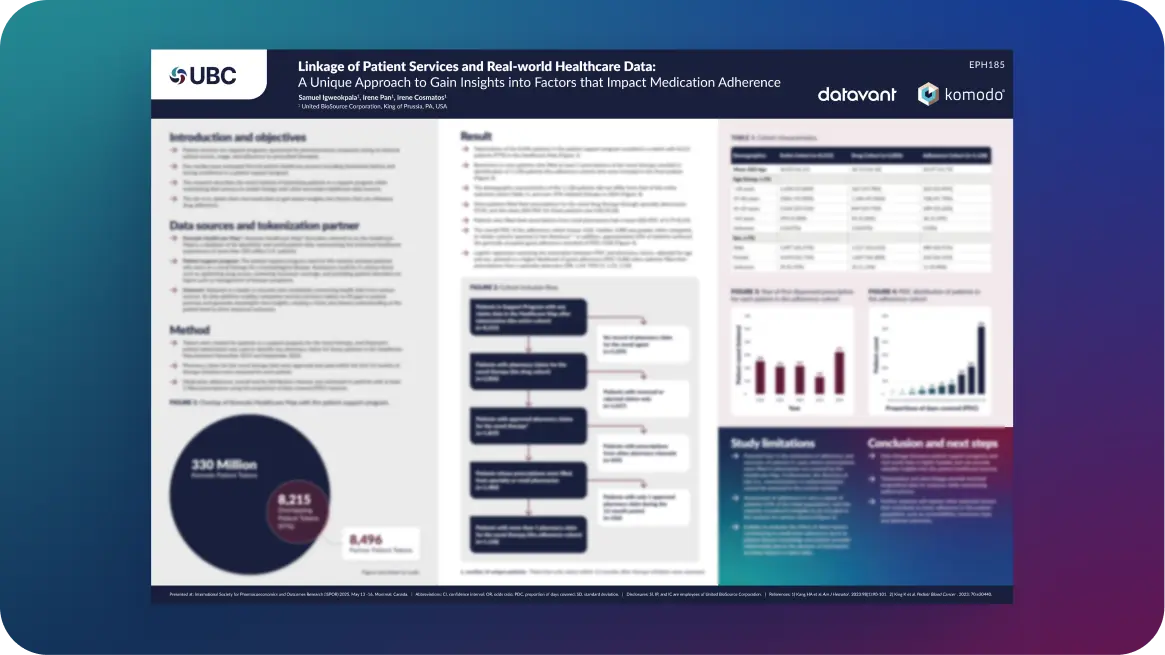
Patient support programs are sponsored by pharmaceutical companies to improve patient access, usage, and adherence to prescribed therapies. Few studies have evaluated the full patient healthcare journey, including treatments before and during enrollment in a patient support program.
The research detailed here describes a novel method of tokenizing patients in a support program while maintaining their privacy to enable linkage with other secondary healthcare data sources. The aim is to obtain real-world data (RWD) to gain better insights into factors that can influence drug adherence.
Key Steps
Data Sources: This analysis used patient data from a support program for a novel hematological therapy and linked it to the Komodo Healthcare Map, a database of de-identified, real-world patient data representing over 330 million U.S. patients.
Tokenization: Tokens were created for 8,496 patients in the support program. Datavant’s patient tokenization was used to securely and compliantly match them with pharmacy claims in the Komodo Healthcare Map between November 2019 and September 2024.
Cohort Selection: Tokenization resulted in a 97% match (n=8,215). The final adherence cohort was restricted to patients who filled at least two approved prescriptions of the novel therapy within 12 months, resulting in 1,128 patients for the final analysis.
Adherence Measure: Medication adherence was estimated using the Proportion of Days Covered (PDC) measure.
Results and Findings
High Adherence Rate
The overall PDC of the adherence cohort was 0.82 (median: 0.88), which was greater when compared to similar cohorts reported in the literature. Approximately 65% of patients achieved the generally accepted good adherence standard of PDC ≥ 0.80.
Pharmacy Channel Impact
Most patients (91%) filled their prescriptions through specialty pharmacies.
Patients using specialty pharmacies had a mean (SD) PDC of 0.82 (0.20)
Patients using retail pharmacies had a mean (SD) PDC of 0.79 (0.24)
Higher Likelihood of Adherence from Specialty Pharmacy
Logistic regression, adjusted for age and sex, pointed to a higher likelihood of good adherence (PDC ≥ 0.80) when patients filled their prescriptions from a specialty pharmacy (OR: 1.69, 95% CI: 1.23, 2.33).
Conclusion and Next Steps
Data linkage between patient support programs and real-world databases is highly feasible and can provide valuable insights into the patient healthcare journey. Tokenization and data linkage provide enriched longitudinal data for analyses while maintaining patient privacy. Further analyses will explore other potential factors that contribute to medication adherence, such as comorbidities, insurance type, and adverse outcomes.
Integrated RWD/RWE Insights for Drug Adherence
Download the scientific poster to see how patient tokenization securely links support program data with real-world claims to identify adherence factors, such as the impact of specialty versus retail pharmacies.
Read UBC’s white paper for how PV data management practices can adapt to an evolving data landscape while maintaining adherence to rigid regulatory reporting and data quality standards.
The strategic integration of technology and data is crucial for today’s patient services program. Explore key principles, enablers, and actionable steps to achieve the most appropriate tech-enabled patient access program.
Bekki Bracken Brown serves as the President and CEO of UBC, guiding the company’s mission and values, including the improvement of access for patients to receive better outcomes. She oversees all aspects of UBC, such as operations, business growth strategy, sales and marketing, and acquisition support.
With over 20 years of industry experience, Ms. Brown brings knowledge from a successful career in senior management from her tenure at Quintiles, INC Research, and, most recently, with Syneos Health. She’s been a member of the North Carolina BIO Board of Directors since 2019. She is also a member of the Healthcare Businesswomen’s Association — Southeast Chapter and CHIEF, an organization that supports women executive leaders. Ms. Brown earned her bachelor’s degree at Duke University.