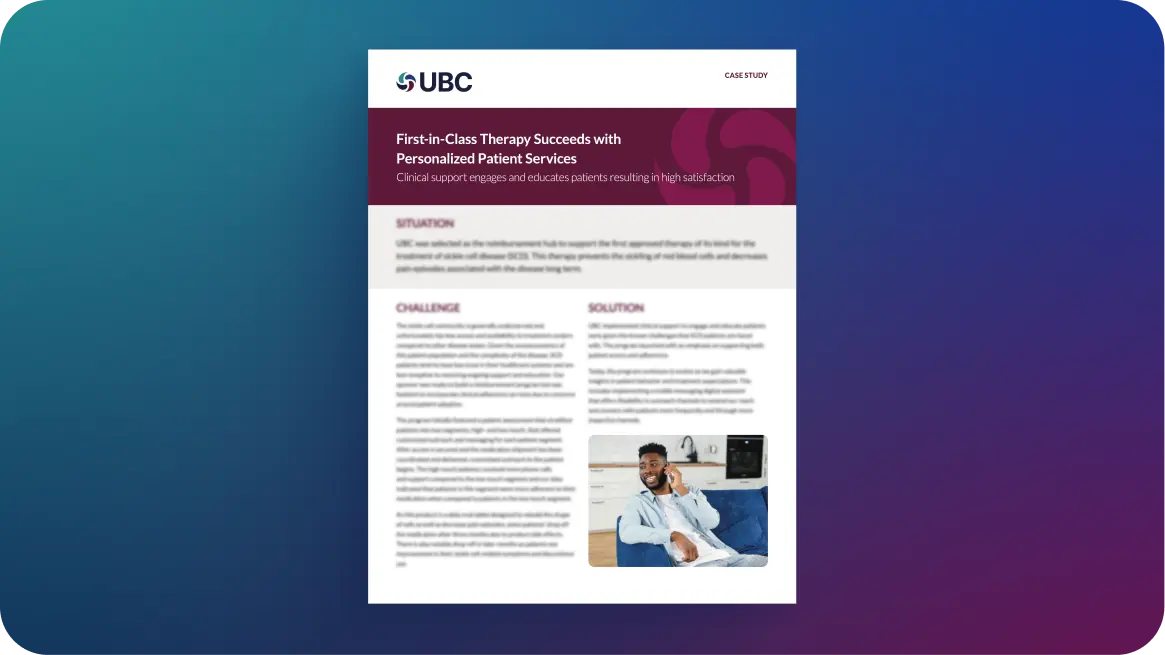
UBC was selected as the reimbursement hub to support the first approved therapy of its kind for the treatment of sickle cell disease (SCD), a therapy that prevents the sickling of red blood cells and decreases associated long-term pain episodes.
The Challenge: An Underserved Community
UBC was selected as the reimbursement hub for this groundbreaking therapy. Despite the therapy’s potential, the sponsor immediately encountered significant barriers:
The sickle cell community is generally underserved and has less access and availability to treatment centers.
SCD patients may exhibit less trust in their healthcare systems and be less receptive to ongoing support due to the complexity and socioeconomics of the disease.
Known drop-off points exist at three months (due to side effects) and later (as symptoms improved).
Knowing this, UBC quickly advocated to include patient education and adherence services to the program.
Purpose-Built, Nimble Support
Carefully considering the patient population and indication before design and launch, UBC customized the program to better meet the needs of patients. UBC’s nimble approach and integrated model included:
Customized Clinical Support
The program launched with an emphasis on both patient access and adherence. Clinical support was implemented to engage and educate patients early.
Targeted Interventions
A dedicated clinician model focused on providing intervention calls around the known therapy stop points, building rapport, and educating patients on side effect management.
Hybrid Access Model
The integrated approach, consisting of both reimbursement and clinical care teams, acts as a champion for access and affordability by conducting benefit investigations and supporting prior authorizations.
Digital Flexibility
The program continues to evolve, implementing a mobile messaging digital assistant to offer flexibility in outreach channels and connect with patients more frequently.
The Result: High Satisfaction and Strong Patient Adherence
UBC’s approach to addressing patient barriers led to incredibly high satisfaction scores and strong adherence to therapy for enrolled patients.
The program has seen success during treatment initiation as well as providing ongoing support to help patients stay adherent over the long term.
Adherence Improvement: Patients enrolled into the program are on average 15% more adherent to therapy than those not enrolled in the patient access program.
Hub Satisfaction: 97% of patients were very satisfied with the hub services.
Education Satisfaction: 100% of patients were very satisfied with refill reminders.
Clinical Education: 100% of patients were very satisfied with the sickle cell disease education provided.
Build Patient Trust and Boost Treatment Adoption
Explore the case study to learn how UBC’s purpose-built programs best meet the needs of patients, and how a combined reimbursement and patient education hub spurred greater adherence for an underserved patient population receiving a first-in-class therapy.
Read UBC’s white paper for how PV data management practices can adapt to an evolving data landscape while maintaining adherence to rigid regulatory reporting and data quality standards.
Bekki Bracken Brown serves as the President and CEO of UBC, guiding the company’s mission and values, including the improvement of access for patients to receive better outcomes. She oversees all aspects of UBC, such as operations, business growth strategy, sales and marketing, and acquisition support.
With over 20 years of industry experience, Ms. Brown brings knowledge from a successful career in senior management from her tenure at Quintiles, INC Research, and, most recently, with Syneos Health. She’s been a member of the North Carolina BIO Board of Directors since 2019. She is also a member of the Healthcare Businesswomen’s Association — Southeast Chapter and CHIEF, an organization that supports women executive leaders. Ms. Brown earned her bachelor’s degree at Duke University.