



Currently, less than 5% of eligible patients participate in clinical studies, with a notable lack in racial and ethnic minority participants (1). The FDA is addressing this gap, culminating in the June 2024 draft guidance: Diversity Action Plans to Improve Enrollment of Participants from Underrepresented Populations in Clinical Studies. This guidance requires sponsors to develop Diversity Action Plans for certain clinical studies.
Underrepresentation in Clinical Trials & Why Diversity Matters
Global and U.S. clinical trial participation often fails to reflect the real-world patient populations they intend to serve (2). Ensuring inclusion of representative populations is essential for several reasons:
- It supports the generalizability of clinical research to the larger U.S. population with the disease.
- It promotes innovation through exploration of the heterogeneity of treatment effects.
- It results in the potential for greater enrollment in studies.
- It helps to address health disparities and inequity.
Sponsors also have a business case for improving diversity, including the potential for shortening approval timelines and gaining an advantage over competitors.
A Three-Pronged Approach to Diversity Action Planning

1) Establish Enrollment Goals and Geolocate Patient Subpopulations
Sponsors must consider multiple factors when setting enrollment goals, including: demographic characteristics (age, sex, race, ethnicity), disease incidence and prevalence, and clinical characteristics.
- Understand the Patient Population: A comprehensive literature review is essential to establish incidence, prevalence, define the patient journey, and identify biomarkers
- Use Real-World Data (RWD): RWD assessments supplement the literature review for proper geo-targeting. Using age, sex, race, and ethnicity as criteria, “geographic hot spots” can be identified to highlight where relevant patients and/or providers are clustered

2) Engage Diverse Populations
Since each underrepresented patient population has unique needs and barriers, it is critical to incorporate the patient voice and engage community leaders when developing recruitment and retention plans.
- Partner with groups that patients already trust to enhance credibility.
- Offer travel reimbursement or remote participation options.
- Ensure materials are free of medical jargon and translated if needed.
- Bring trials to the patient, offering evening and weekend hours.

3) Improve Diversity Leveraging Modernized Study Designs (MSDs)
MSDs incorporate decentralized or hybrid approaches to supplement traditional site-based designs. MSDs meet participants where they live, work, and play, allowing some or all visits to occur outside the site using digital health, telemedicine, or in-home nursing.
- Accessing a wider range of participants via MSD methodologies provides faster patient enrollment and higher retention rates (3).
- The use of a central site can combine a technology platform, in-home/telehealth visits, and traditional site support to reduce patient and caregiver burden.
Ensure your clinical study is compliant with FDA Draft Guidance as early as possible
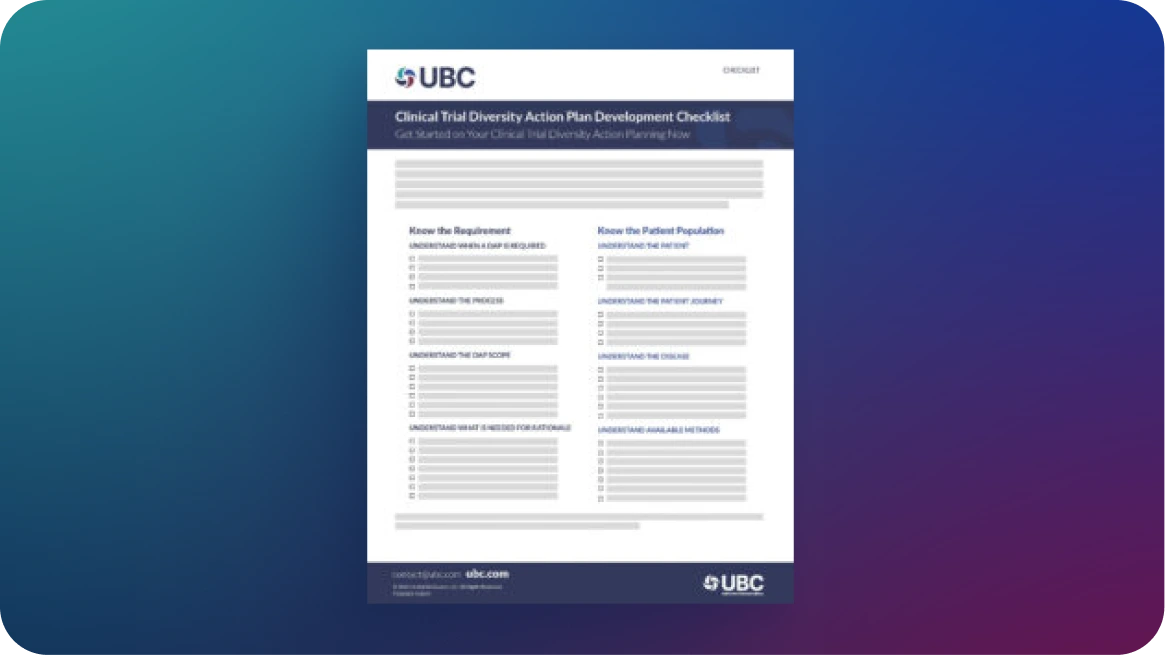
Combining a depth of expertise across patient advocacy and recruitment, epidemiology, clinical operations, modernized real-world study design and execution, and strategic planning, our checklist will help you assess critical Diversity Action Plan considerations.
References
- Goodson, N., Wicks, P., Morgan, J. et al. Opportunities and counterintuitive challenges for decentralized clinical trials to broaden participant inclusion. npj Digit. Med. 5, 58 (2022). https://doi.org/10.1038/s41746-022-00603-y
- Turner B., Steinberg J., Weeks B., Rodriguez F., and Cullen M. Race/ethnicity reporting and representation in US clinical trials: A cohort study. The Lancet Regional Health – Americas. Volume 11, 100252 (2022). DOI: https://doi.org/10.1016/j.lana.2022.100252
- Fierce Biotech. Not just for a pandemic: Decentralized clinical trials pay off financially, study finds. Accessed August 9, 2024. https://www.fiercebiotech.com/cro/decentralized-studies-offer-financial-benefits-says-new-study