

The problem
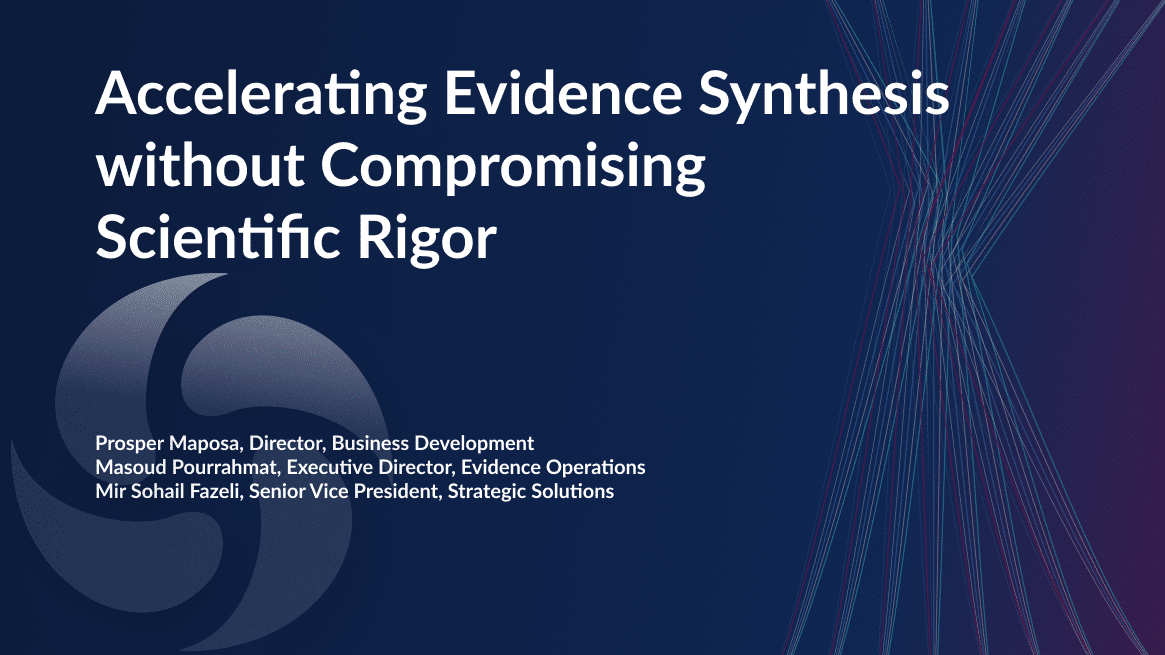
Evidence synthesis is being asked to move faster than it safely can
A rising tide of publications, shrinking submission windows, and cost pressure are making the fully manual literature review difficult to sustain. AI can screen tens of thousands of abstracts in minutes. But AI is a tool, not a scientist.
Without expert judgment at every critical step, AI-enabled reviews produce fast answers to the wrong questions.
The model
AI accelerates. Experts decide.
Expert-guided AI is neither fully manual nor fully automated. Technology carries the repetitive work; trained methodologists retain every decision that determines whether the evidence base survives peer review or HTA scrutiny.
AI accelerates
Repetitive, high-volume tasks
- Title and abstract screening
- Full-text screening
- Data extraction
- Risk of bias assessment
- Report writing
Experts decide
Judgment that cannot be delegated
- Study design
- Clinical interpretation
- Quality assurance
- Scientific accountability
What it delivers
Validated across the stages that consume the most time
Screening is where compressed HTA and Joint Clinical Assessment timelines bite hardest, and where expert-guided AI returns the most time without loosening the standard.
95%
Reduction in title and abstract screening time
Achieved while maintaining high sensitivity for identifying relevant studies, with every screening decision reviewed by an expert before it enters the evidence base.
96%
Reduction in first-pass full-text screening time
Demonstrated high sensitivity and negative predictive value, supporting use as an efficient first-pass tool when coupled with expert review.
Validation results and full citations are in the white paper.
Authors
Prosper Maposa
Director, Business Development
Masoud Pourrahmat
Executive Director, Evidence Operations
Mir Sohail Fazeli
Senior Vice President, Strategic Solutions
Accelerate evidence synthesis with expert judgment at every decision point.
Get the full white paper for the eight-stage expert-guided workflow, the governance controls that keep AI-assisted reviews auditable, and where seven HTA bodies stand on AI in evidence generation.