


Abstract
Drug development has traditionally relied on clinical, biological and imaging outcomes to demonstrate whether a treatment works. Clinical outcome assessments (COAs), particularly patient-reported outcomes (PROs), have progressively added another essential dimension: how patients feel and function. Regulatory agencies have accelerated this evolution by promoting patient-focused drug development and the systematic collection of patient experience data. Yet most PRO instruments remain standardized: researchers determine in advance what will be measured, and every patient is generally asked the same questions. The next step may be to complement these standardized measures with more personalized outcomes that identify what matters most to each patient. This evolution from measuring disease to measuring the patient’s experience of disease, and ultimately to measuring what matters to the individual patient, could strengthen both drug development and personalized medicine.
The progressive need to go beyond disease-related outcomes
At its core, drug development asks a simple question: does a treatment make a meaningful difference? The difficulty lies in defining “meaningful” and deciding whose perspective should determine it.
Clinical trials have traditionally relied on outcomes such as survival, hospitalization, laboratory values, imaging findings or other measures of disease activity. These outcomes remain indispensable because theydemonstrate that a treatment reduces a biomarker, changes an imaging finding, slows tumor growth, prevents hospitalization or prolongs survival. These outcomes can provide compelling evidence of biological activity or clinical benefit. But they do not always tell us how a patient feels, functions in daily life, or experiences the balance between treatment benefit and treatment burden.
Typically, a patient may ask different questions: Will I have less pain? Will fatigue interfere less with my work or family life? Will I be able to walk farther, sleep better, or return to an activity that matters to me?
These questions helped drive the development of COAs. Among COAs, PROs have played a particularly important role because they allow information to come directly from patients without interpretation by clinicians or other observers [1]. The FDA’s patient-focused drug development framework now explicitly seeks to incorporate patients’ experiences, perspectives, needs and priorities into medical product development and evaluation [1-4].
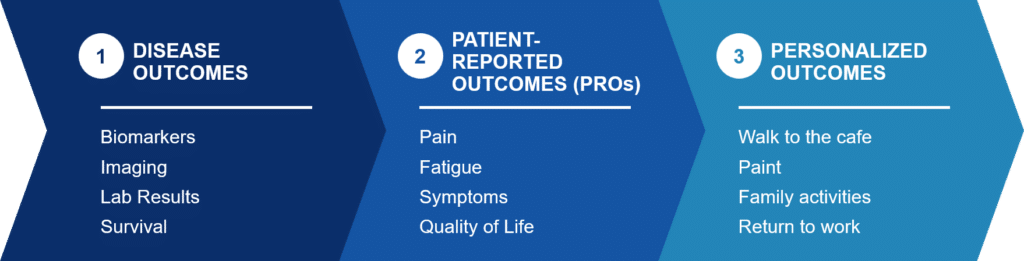
The evolution is important. We first measured what happens to the disease. We increasingly measure what happens to the patient. The next question is whether we are measuring what matters most to the individual patient.
COAs: The assessment is not the outcome
The word assessment is important. A clinical outcome is an aspect of how a person feels, functions or survives. A clinical outcome assessment is the method used to measure that outcome [2].
Pain, for example, is an outcome. A validated 0–10 pain rating scale is an assessment used to measure it. Similarly, mobility may be an outcome, while a standardized walking test is one possible way of assessing it.
The FDA distinguishes four major types of COAs [1,2].
| Type of COA | Who provides the assessment? | Example |
| Patient-reported outcome (PRO) | Patient directly | Pain, fatigue, symptoms, health-related quality of life |
| Observer-reported outcome (ObsRO) | Parent, caregiver or other non-clinical observer | Observable behavior in a young child unable to self-report |
| Clinician-reported outcome (ClinRO) | Trained healthcare professional | Clinician assessment of observable signs or disease severity |
| Performance outcome (PerfO) | Patient performs a standardized task | Walking test, cognitive task, visual acuity test |
The appropriate assessment therefore depends on what is being measured. Pain or fatigue can only truly be known by the person experiencing it and are naturally suited to PRO measurement. An infant’s observable behavior may require an ObsRO. A clinical sign requiring professional interpretation may require a ClinRO, while physical or cognitive ability may sometimes be assessed through a standardized performance task [2-3].
Introduction of PROs in drug development
PROs introduced something fundamentally different into drug evaluation: the patient’s experience became data, to complement the classic disease-related outcomes. Disease outcomes include clinical measures like for instance the tumor size, imaging or biomarkers. A PRO may measure symptoms, physical functioning, emotional well-being, treatment satisfaction or health-related quality of life. Some instruments are generic, such as the EQ-5D, allowing comparison across diseases. Others are disease-specific and designed to capture problems particularly relevant to a given condition. Both FDA and EMA strongly recommended the addition of PROs in clinical studies for regulatory submissions (next section). The patient’s voice became a new outcome, along with standard disease-related outcomes.
But using a questionnaire does not automatically make the information scientifically useful. If an instrument is going to contribute to a clinical trial or regulatory decision, it must be fit for its intended purpose. Its development therefore requires evidence that it measures concepts relevant to the target population and has adequate measurement properties, including content validity, reliability, construct validity and ability to detect change [3,4].
A standardized instrument permits comparison between patients, treatment groups and sometimes studies. However, standardization means that investigators have already decided which questions are important. The patient reports the answer, but generally does not select the question. This creates an important paradox. Standardization is one of the great strengths of PROs, but it is also one of their limitations as concepts and questions are determined in advance.
Regulatory agencies have helped move drug development closer to the patient
The growing importance of the patient’s voice has not occurred only because of academic interest. Regulatory agencies, particularly the FDA, have actively encouraged patient-focused drug development. The FDA’s Patient-Focused Drug Development (PFDD) methodological guidance series provides a useful illustration of this evolution [5-8].
Guidance 1 – Collecting Comprehensive and Representative Input addresses how to obtain meaningful and sufficiently representative information from patients and caregivers about disease burden and treatment experience [5].
Guidance 2 – Methods to Identify What Is Important to Patients moves a step further. The objective is not simply to collect information from patients but to determine systematically which aspects of disease and treatment matter to them [6].
Guidance 3 – Selecting, Developing or Modifying Fit-for-Purpose Clinical Outcome Assessmentsconnects those patient priorities to measurement. Once the relevant concept has been identified, an appropriate COA must be selected, adapted or developed and supported by adequate evidence for its intended context of use [7].
Finally, Guidance 4 – Incorporating Clinical Outcome Assessments into Endpoints for Regulatory Decision-Making addresses how COA data can be incorporated into trial endpoints, analyzed and interpreted—including how meaningful change can be established [8]. As of 2026, Guidance 4 remains draft guidance, whereas Guidance 3 was finalized in 2025.
Taken together, these documents describe an important progression: from (i) Listening to patients, to (ii) identifying what matters, then to (iii) measuring it appropriately and finally to (iv) determining whether treatment produces meaningful change.
The European Medicines Agency (EMA) is moving in a closely related direction. Its work on patient experience data encompasses PROs, patient preferences, patient engagement, patient-generated digital data and information collected from clinical trials and real-world settings. It also encourages early discussion of patient experience data within development programs [9].
PROs throughout the drug development cycle
The value of patient-reported information does not end when a drug receives marketing authorization. Health technology assessment (HTA) bodies must consider not only whether a treatment has biological or clinical activity but also the magnitude of the health benefit it produces relative to its costs. Measures of health-related quality of life can therefore become important inputs to economic evaluation.
Patient-reported and other clinical outcomes remain important after approval. Randomized trials are conducted in selected populations under controlled conditions and over predefined periods. Post-marketing real-world evidence can examine how patients actually feel and function during longer-term treatment, in broader and more heterogeneous populations, and under usual clinical-care conditions.
The opportunity is therefore to view COAs not simply as clinical-trial instruments, but as measures that can accompany a treatment throughout its lifecycle, from clinical development to regulatory assessment, HTA, routine practice and post-marketing RWE.
How much are PROs actually used?
PROs are now common in clinical research, although their use varies considerably by therapeutic area and study purpose. A review of 303 randomized trials published through the UK Health Technology Assessment programme found that 37.6% used a PRO as a primary outcome and 82.8% used PROs as secondary outcomes [10]. These figures reflect the particular portfolio of HTA-funded trials and should not be generalized to all pharmaceutical trials, but they demonstrate how extensively PROs can be incorporated into comparative effectiveness research.
The pattern can look very different in registration-oriented pharmaceutical research. A 2024 systematic review of 90 phase III randomized trials in hematological malignancies found that 73% included a PRO endpoint, but only one trial (1%) used a PRO as the primary endpoint. PROs were much more commonly secondary (56%) or exploratory (17%) endpoints [11]. Furthermore, PRO results appeared in the primary publication for only 26trials of the 66 (39%) that had included a PRO endpoint [13]. In oncology more broadly, under-reporting and delayed reporting of quality-of-life outcomes have also been documented [12].
This pattern is not necessarily a weakness of PROs. Mortality, disease progression, major clinical events or objective response may appropriately remain primary efficacy endpoints. PROs can add a different dimension: two treatments with similar disease control may differ substantially in fatigue, functioning, symptoms or treatment burden. Conversely, a therapy that improves disease control may impose adverse effects that matter greatly to patients. PROs help place efficacy into a broader benefit-risk context.
The next step: from patient-reported to patient-meaningful outcomes
Despite their importance, conventional PROs retain a fundamental limitation that can be summarized by patients with the same diagnosis do not necessarily value the same outcomes. Consider two people with the same chronic neurological disease. For one, the most important goal might be walking independently from the house to a nearby café. For another, it might be having sufficient hand control to continue painting. A third patient might primarily want enough energy to attend a child’s activities. A standardized physical-function or fatigue questionnaire may capture part of each experience, but it may not fully capture what would constitute success for that individual.
This is where the concept of patient-meaningful outcomes (PMOs) becomes particularly interesting. Rather than beginning exclusively with What does our instrument measure?, the process begins with: What matters most to this patient? Goal Attainment Scaling (GAS) offers one established approach to individualized outcome assessment. Patient-specific goals are defined, and subsequent attainment can be quantified. GAS has been used across diverse conditions and is particularly attractive in heterogeneous populations where the same disease can affect patients very differently [13,14].
A review of GAS implementation identified hundreds of clinical studies using the approach, including interventional trials and rare-disease applications [14]. At the same time, earlier systematic evaluation identified important limitations in evidence regarding validity, responsiveness and reliability for drug-development applications [13]. This tension is important. Personalization increases relevance but may decrease standardization.
Personalized outcomes development is not to replace standardized PROs in drug development, but they may become an important complement to them. The two approaches should therefore not be viewed as competitors. A standardized PRO can answer whether a treatment improves pain, fatigue or physical function on average. A personalized outcome can add another question: Did the treatment change something this particular patient considered important enough to matter?
Figure 1: Evolution from disease-centered outcomes to patient-reported outcomes and ultimately personalized outcomes reflecting what matters most to each patient.
Conclusion: measuring what matters
Outcome assessment in drug development has undergone a profound evolution. We first asked whether treatment changed the disease. Biomarkers, imaging, clinical events and survival remain essential for answering that question.
We then increasingly asked whether treatment changed how patients feel and function. COAs, and particularly PROs, gave the patient’s experience a formal place in clinical trials and regulatory evaluation.
The emerging question goes one step further: are we measuring the outcomes that matter most to the individual patient?
References
- U.S. Food and Drug Administration. CDER Patient-Focused Drug Development. Silver Spring (MD): FDA; updated 2026. Available from: https://www.fda.gov/drugs/development-approval-process-drugs/cder-patient-focused-drug-development
- U.S. Food and Drug Administration. Clinical Outcome Assessment Compendium. Silver Spring (MD): FDA. Available from: https://www.fda.gov/drugs/development-resources/clinical-outcome-assessment-compendium
- U.S. Food and Drug Administration. Patient-Focused Drug Development: Selecting, Developing, or Modifying Fit-for-Purpose Clinical Outcome Assessments. Guidance for Industry, FDA Staff, and Other Stakeholders. Silver Spring (MD): FDA; 2025. Available from: https://www.fda.gov/regulatory-information/search-fda-guidance-documents/patient-focused-drug-development-selecting-developing-or-modifying-fit-purpose-clinical-outcome
- U.S. Food and Drug Administration. FDA Patient-Focused Drug Development Guidance Series for Enhancing the Incorporation of the Patient’s Voice in Medical Product Development and Regulatory Decision Making. Available from: https://www.fda.gov/drugs/development-approval-process-drugs/fda-patient-focused-drug-development-guidance-series-enhancing-incorporation-patients-voice-medical
- U.S. Food and Drug Administration. Patient-Focused Drug Development: Collecting Comprehensive and Representative Input. Guidance for Industry, FDA Staff, and Other Stakeholders. Silver Spring (MD): FDA; 2020. Available from: https://www.fda.gov/regulatory-information/search-fda-guidance-documents/patient-focused-drug-development-collecting-comprehensive-and-representative-input
- U.S. Food and Drug Administration. Patient-Focused Drug Development: Methods to Identify What Is Important to Patients. Guidance for Industry, FDA Staff, and Other Stakeholders. Silver Spring (MD): FDA; 2022. Available from: https://www.fda.gov/regulatory-information/search-fda-guidance-documents/patient-focused-drug-development-methods-identify-what-important-patients
- U.S. Food and Drug Administration. Patient-Focused Drug Development: Selecting, Developing, or Modifying Fit-for-Purpose Clinical Outcome Assessments. Silver Spring (MD): FDA; 2025. Available from: https://www.fda.gov/regulatory-information/search-fda-guidance-documents/patient-focused-drug-development-selecting-developing-or-modifying-fit-purpose-clinical-outcome
- U.S. Food and Drug Administration. Patient-Focused Drug Development: Incorporating Clinical Outcome Assessments Into Endpoints for Regulatory Decision-Making. Draft Guidance. Silver Spring (MD): FDA; 2023. Available from: https://www.fda.gov/regulatory-information/search-fda-guidance-documents/patient-focused-drug-development-incorporating-clinical-outcome-assessments-endpoints-regulatory
- European Medicines Agency. Reflection paper on patient experience data. EMA/CHMP/PRAC/148869/2025. Amsterdam: EMA; 2025. Available from: https://www.ema.europa.eu/en/patient-experience-data-ped-reflection-paper
- Qian Y, Walters SJ, Jacques R, Flight L. Comprehensive review of statistical methods for analysing patient-reported outcomes (PROs) used as primary outcomes in randomised controlled trials (RCTs) published by the UK’s Health Technology Assessment journal (1997-2020). BMJ Open. 2021;11(9):e051673. doi:10.1136/bmjopen-2021-051673. Available from: https://doi.org/10.1136/bmjopen-2021-051673
- Patel K, Ivanov A, Jocelyn T, Hantel A, Garcia JS, Abel GA. Patient-reported outcomes in phase 3 clinical trials for blood cancers: a systematic review. JAMA Netw Open. 2024;7(6):e2414425. doi:10.1001/jamanetworkopen.2024.14425. Available from: https://doi.org/10.1001/jamanetworkopen.2024.14425
- Marandino L, La Salvia A, Sonetto C, et al. Deficiencies in health-related quality-of-life assessment and reporting: a systematic review of oncology randomized phase III trials published between 2012 and 2016. Ann Oncol. 2018;29(12):2288-2295. doi:10.1093/annonc/mdy449. Available from: https://doi.org/10.1093/annonc/mdy449
- Gaasterland CMW, Jansen-van der Weide MC, Weinreich SS, et al. A systematic review to investigate the measurement properties of Goal Attainment Scaling, towards use in drug trials. BMC Med Res Methodol. 2016;16:99. doi:10.1186/s12874-016-0205-4. Available from: https://doi.org/10.1186/s12874-016-0205-4
- George M, Chapman CAT, Howlett SE, Rockwood K, Sevinc G. A review of Goal Attainment Scaling implementation as a personalized clinical outcome assessment over the last decade. Value Health. 2024;27(6 Suppl):S18. doi:10.1016/j.jval.2024.03.101

About UBC
United BioSource LLC (UBC) is the leading provider of evidence development solutions with expertise in uniting evidence and access. UBC helps biopharma mitigate risk, address product hurdles, and demonstrate safety, efficacy, and value under real-world conditions. UBC leads the market in providing integrated, comprehensive clinical, safety, and commercialization services and is uniquely positioned to seamlessly integrate best-in-class services throughout the lifecycle of a product.
About the Authors

Jean-Paul Collet, MD, PhD, Chief Scientific Officer, Evidinno Outcomes Research
Dr. Jean-Paul Collet stands as a distinguished senior scientist boasting an impressive portfolio of over 200 peer-reviewed publications, showcasing a pronounced expertise in drug evaluation methodology, economic impact, and outcomes research. Since 2006, he has held the dual roles of Professor and Associate Head of Research within UBC’s Department of Pediatrics. His proactive pursuit of research funding has culminated in the successful acquisition of competitive grants, amassing a total value exceeding $30 million.
Beyond his accolades, Jean-Paul’s influence extends to mentorship, having adeptly guided more than 50 students through the culmination of their Master of Science (MSc), PhD, and postdoctoral endeavors. Evidinno benefits from his wealth of knowledge in real-world evidence and patient-centered research, as he enriches the organization’s research and consulting endeavors. Jean-Paul’s educational journey is equally remarkable, comprising an MSc in Health Economics from the esteemed Lyon Faculty of Medicine in France and a PhD in Epidemiology from the distinguished McGill University. His comprehensive contributions underscore his commitment to advancing research and shaping the future of the field. Jean-Paul’s educational journey is equally remarkable, comprising an MSc in Health Economics from the esteemed Lyon Faculty of Medicine in France and a PhD in Epidemiology from the distinguished McGill University. His comprehensive contributions underscore his commitment to advancing research and shaping the future of the field.

Walid Shouman, MSc, Associate Research Scientist, Evidinno Outcomes Research
Walid Shouman serves as Associate Research Scientist at Evidinno Outcomes Research, a UBC company. In this role, he supports real-world evidence, evidence synthesis and health economics and outcomes research (HEOR) projects that help biopharma sponsors generate evidence for regulatory, health technology assessment and market access decisions.