


Health Technology Assessment (HTA) in the European Union has entered a new phase with the implementation of Joint Clinical Assessments (JCAs). Established under Regulation (EU) 2021/2282, the JCA framework is designed to support Member States by providing a common scientific analysis of the relative clinical effects of medicinal products and certain medical devices. The framework is intended to reduce duplication across national HTA processes, improve consistency in evidence assessment, and support more efficient decision-making across Europe.1
The first implementation phase began on 12 January 2025 for new oncology medicines and advanced therapy medicinal products, making these areas the earliest test cases for the new system. Because many oncology, orphan, and advanced therapies enter assessment with immature survival data, single-arm studies, or highly selected trial populations, the role of real-world evidence has become strategically important.
Real-world data (RWD) are routinely collected data relating to patient health status or healthcare delivery, including electronic health records, disease registries, claims databases, hospital data, and other prospective patient-generated data. Real-world evidence (RWE) is the clinical evidence derived from the analysis of these data. Within JCA, RWE should be viewed not as a substitute for randomized evidence but as a complementary evidence stream that can clarify context, reduce uncertainty, and strengthen interpretation of comparative clinical benefit.2 The European Medicines Agency (EMA) uses RWE to support regulatory decision-making and has established DARWIN EU® to provide timely evidence on medicine use, safety, and effectiveness from real-world healthcare databases across Europe.3 Although randomized comparative evidence has historically been the preferred foundation for JCA assessments, early experience suggests that sponsors will increasingly need rigorously designed RWE to address the evidence gaps that randomized studies alone cannot address. 4
Uses of Real-World Evidence in JCA
Within JCA, the greatest value of RWE is not just additional data generation but reducing decision uncertainty at critical assessment milestones across the evidence lifecycle, e.g., by contextualizing treatment effects, strengthening interpretation of indirect comparisons, supporting extrapolation. Across the first published JCAs, reviewers consistently focused on comparator relevance, the credibility and assumptions of indirect treatment comparisons, small sample sizes, immature survival data, and residual uncertainty where evidence relied on single-arm trials or limited comparative data.
| JCA Challenge | Potential RWE Solution |
| Single arm trials | External control arms |
| Immature OS | Longitudinal registry |
| Comparator mismatch | Real-World treatment patterns |
| Rare disease uncertainty | Natural history studies |
| Limited generalizability | Routine care analyses |
Early evidence planning
During the early evidence planning phase, RWE can help developers understand the real-world clinical landscape in which a new health technology will be assessed under the JCA framework. Data sources such as disease registries, electronic health records (EHRs), claims databases, and administrative healthcare databases can provide insights into the epidemiology, natural history, treatment patterns, and outcomes of the target population.5 RWE can support early planning by characterizing disease burden and unmet need. This is particularly important for rare diseases, advanced cancers, and conditions with heterogeneous clinical presentations, where RCTs may include highly selected populations that do not fully represent routine clinical practice. Moreover, RWE can highlight areas where evidence from RCTs may be insufficient, such as long-term outcomes, rare patient subgroups, treatment effectiveness in routine practice, or outcomes that are important to patients and healthcare systems. These gaps can inform prospective evidence generation plans, including registry development, pragmatic studies, or post-launch data collection strategies.
Informing the PICO scoping process
Within the EU JCA, the PICO scoping process is a critical early step that defines the scope of the assessment. It specifies the Population, Intervention, Comparator, and Outcomes (PICO) that will be used to evaluate the relative clinical effectiveness and safety of a health technology. Unlike traditional HTA processes in individual countries, the JCA PICO must accommodate the needs of multiple EU Member States, each of which may have different clinical guidelines, treatment pathways, reimbursement criteria, and standards of care.6,7
RWE can play an important role in informing the JCA PICO scoping process by providing an objective understanding of how diseases are managed in routine clinical practice across different healthcare systems. Unlike randomized controlled trials, which often reflect protocol-driven settings and highly selected patient populations, RWE captures actual clinical practice, making it valuable for defining PICOs that are relevant to real-world decision-making.
RWE is particularly valuable for selecting Comparators, one of the most challenging aspects of JCA scoping. Standard-of-care treatments often differ between European countries because of variations in reimbursement policies, clinical guidelines, product availability, and physician practice. Real-world treatment data can identify the therapies most commonly used in routine practice, quantify regional differences in treatment patterns, and demonstrate which comparators are clinically relevant across different healthcare settings. This evidence can help justify comparator selection and identify circumstances where multiple comparators or individualized treatment approaches may be appropriate.
Supporting relative effectiveness evaluation in JCA
When direct head-to-head trials are unavailable, RWE may support external control arms, synthetic comparators, or observational comparative effectiveness studies. Such analyses should be designed around a clearly defined causal question and should use methods such as propensity score adjustment, inverse probability weighting, marginal structural models, or target trial emulation where appropriate. The credibility of these analyses depends on whether the data capture all important confounders and whether sensitivity analyses test the robustness of findings.8
Additionally, many therapies, particularly oncology medicines and advanced therapies, are expected to deliver long-term benefit that may not be fully observed during clinical development. RWE can extend follow-up for outcomes such as overall survival, progression-free survival, durability of response, late adverse events, treatment persistence, and healthcare utilization.9
RWE can also help in the evaluation of effectiveness in broader routine-care populations. RWE can provide evidence on how therapies perform when used after multiple prior treatments, in combination regimens, or in different sequencing strategies. This evidence can help JCA assess the generalizability and applicability of trial findings across European healthcare settings and patient groups that may be underrepresented in clinical trials.
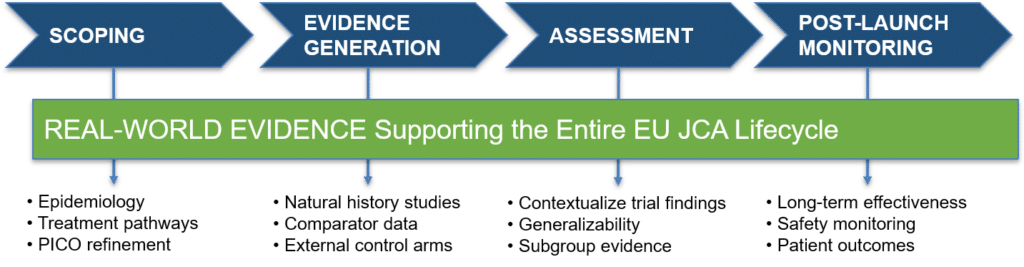
Figure 1: RWE Across the JCA lifecycle
Methodological Considerations for Credible RWE
The EU HTA Regulation (EU) 2021/2282 emphasizes that JCAs should be based on relevant, up-to-date, and high-quality clinical evidence, highlighting the importance of evidence that is appropriate for addressing the clinical assessment question.10 The EUnetHTA 21 JCA methodological guidance further emphasizes the importance of defining appropriate populations, interventions, comparators, and outcomes (PICO), ensuring evidence applicability, and transparently addressing uncertainties and limitations.11
To be useful in JCA, RWE must be planned and reported with the same discipline expected of interventional evidence. The research question should be specified before analysis, the data source should be justified against the PICO, and the study design should make clear how the target population, treatment strategies, eligibility criteria, index date, outcomes, and follow-up are defined.2
Key methodological risks include confounding by indication, immortal time bias, misclassification of exposure or outcomes, missing data, informative censoring, and limited transferability across countries. These risks should be addressed through design choices, analytic adjustment, negative or positive control analyses where relevant, sensitivity analyses, and transparent reporting of residual uncertainty.2
When intended to inform comparative effectiveness assessments, observational studies should emulate a hypothetical randomized controlled trial using a target trial emulation (TTE) framework, with explicit specification of the eligibility criteria, treatment strategies, assignment procedures, start of follow-up (time zero), outcomes, estimands, follow-up duration, and statistical analysis plan. Clearly defining these elements a priori helps reduce common biases, such as immortal time bias, selection bias, and time-varying confounding, thereby improving the validity of causal effect estimates. Equally important is transparent reporting throughout the study lifecycle, including the prospective development and, where appropriate, registration of study protocols and prespecified statistical analysis plans, with any deviations clearly documented and justified. Detailed reporting of data sources, study design decisions, variable definitions, methods for handling missing data and confounding, and the results of prespecified sensitivity analyses further enhances the reproducibility and credibility of RWE.12
Stakeholder Perspectives on the Use of RWE
RWE requirements and expectations differ across stakeholders. Consequently, a single RWE study is unlikely to address all decision-making needs, highlighting the importance of early and strategic evidence planning.
| Stakeholder | Primary objective of RWE |
| EMA | Benefit–risk assessment, long-term safety and effectiveness, evidence in broader populations |
| JCA assessors | Relative clinical effectiveness compared with relevant comparators |
| HTA agencies | Local relevance, treatment pathways, epidemiology, and healthcare resource use |
| Payers | Value assessment, budget impact, treatment utilization, and reimbursement decisions |
| Clinicians | Applicability, effectiveness, and safety in routine clinical practice |
RWE in published JCAs
Review of early published JCAs (including lurbinectedin, tarlatamab, and tovorafenib) suggests that RWE has not yet been widely incorporated into the formal JCA evidence packages. However, the methodological challenges observed in these assessments, particularly reliance on single-arm trials, limited comparator evidence, and uncertainty in rare disease populations, highlight areas where RWE could support future JCAs, including external comparator development, treatment pathway characterization, and long-term effectiveness assessment.13-15
| JCA stage | Key Decision | RWE used |
| PICO scoping | Selection of relevant comparator | Characterization of treatment patterns and standard of care across Member States |
| Evidence generation | Addressing evidence gaps and comparator evidence | External control arms, indirect treatment comparisons, and contextual evidence |
| Assessment | Reducing uncertainty in relative clinical effectiveness | Comparative effectiveness and safety in routine clinical practice; subgroup and long-term effectiveness analyses |
| Post-JCA Monitoring | Assessment of long-term outcomes | Registries and other real-world data sources for long-term effectiveness and safety monitoring |
Conclusion
The EU JCA framework creates a more coordinated European approach to evaluating relative clinical effectiveness, but it also raises the standard for evidence planning. Randomized clinical trials will remain central to JCA; however, they will not always answer every question relevant to European HTA decision-making. RWE can fill important gaps by clarifying disease burden, current practice, comparator relevance, external validity, long-term outcomes, and evidence needs in rare or highly targeted populations.
The value of RWE depends on methodological credibility. Studies must be fit for purpose, transparent, and explicitly connected to the JCA question they are intended to support. For health technology developers, the practical implication is clear: RWE should be integrated early into evidence-generation strategy, not assembled reactively at submission. Organizations that can demonstrate robust, relevant, and transferable RWE will be better positioned to reduce uncertainty, support coherent European assessments, and contribute to timely patient access.
References
- Johns A, Andrade A, Johal S, Ryan J. EU Joint Clinical Assessment: A Framework for Optimising Use with Cost-Effectiveness Decision-Making. Journal of Market Access & Health Policy. 2025;13(4):52.
- Collet J-P. Advancing Healthcare Decision-Making: Real-World Evidence And Its Role In Regulatory And Health Technology Assessment Submissions. 2025.
- Raventos B, Prieto-Alhambra D. Real-world evidence for regulatory purposes: The example of DARWIN EU®. Farmacia Hospitalaria. 2025;49(2):62-64.
- HTACG. Guidance on outcomes for joint clinical assessments. In:2024.
- Berger M, Sox H, Willke R, Brixner D, Eichler H, Goettsch W. Good practices for real-world data studies of treatment and/or comparative effectiveness. recommendations from the Joint ISPOR-ISPE Special Task Force on real-world evidence in health care decision making.2017:20.
- D’Oca K, Darquennes E, Garrigues C, Draganigos A, Steck N. European Joint Clinical Assessment PICO Scoping Process: Analysis of Current Approaches and Recommendations. Journal of Market Access & Health Policy. 2025;14(1):3.
- Sarri G, Liljas B, Abrams KR, Duffield SJ, Bharmal M. Mapping the Use of Real-World Evidence Across the EU Health Technology Assessment Regulation: Methodological Considerations, Challenges, and Opportunities for Harmonization. Journal of Market Access & Health Policy. 2026;14(2):20.
- Collet J, Collet J-P, Shouman W, Fazeli MS. HPR170 Real-World Data for External Controls: Insights From EMA Regulatory Submissions. Value in Health. 2025;28(12):S354-S355.
- Pugeat A, Hernandez R, Shouman W, Pushkarna D, Collet JP, Carita P. Using Real‐World Evidence for Clinical Development to Address the Gap Between Marketing Authorisation and Reimbursement in European Countries: Insights From Literature Review. Journal of evaluation in clinical practice. 2025;31(3):e70090.
- European Parliament and Council of the European Union. Regulation (EU) 2021/2282 of the European Parliament and of the Council of 15 December 2021 on Health Technology Assessment and amending Directive 2011/24/EU. In. Official Journal of the European Union2021.
- EUnetHTA21. Practical Guideline on the Scoping Process, Version 1.0. European Network for Health Technology Assessment;2022.
- Hernán MA, Robins JM. Using big data to emulate a target trial when a randomized trial is not available. American journal of epidemiology. 2016;183(8):758-764.
- HTACG. Joint Clinical Assessment Report – Lurbinectedin. 2026; https://health.ec.europa.eu/document/download/3e0c8eac-10fd-4573-84e8-19cdf9efb384_en?filename=hta_jca_mp_202416_lurbinectedin_report_en.pdf.
- HTACG. Joint Clinical Assessment Report – Tarlatamab. 2026; https://health.ec.europa.eu/document/download/ddff70a2-7bf7-4727-ac83-35a0c37dc0a5_en?filename=hta_jca_mp_202417_tarlatamab_report_en_0.pdf.
- HTACG. Joint Clinical Assessment Report – Tovorafenib. 2026; https://health.ec.europa.eu/document/download/395c2ba0-849a-4f3b-9251-aa2495b3efd7_en?filename=hta_jca_mp_202406_tovorafenib_report_en.pdf.
About UBC
United BioSource LLC (UBC) is the leading provider of evidence development solutions with expertise in uniting evidence and access. UBC helps biopharma mitigate risk, address product hurdles, and demonstrate safety, efficacy, and value under real-world conditions. UBC leads the market in providing integrated, comprehensive clinical, safety, and commercialization services and is uniquely positioned to seamlessly integrate best-in-class services throughout the lifecycle of a product.


About the Author
Walid Shouman, M.Pharm, Associate Research Scientist