

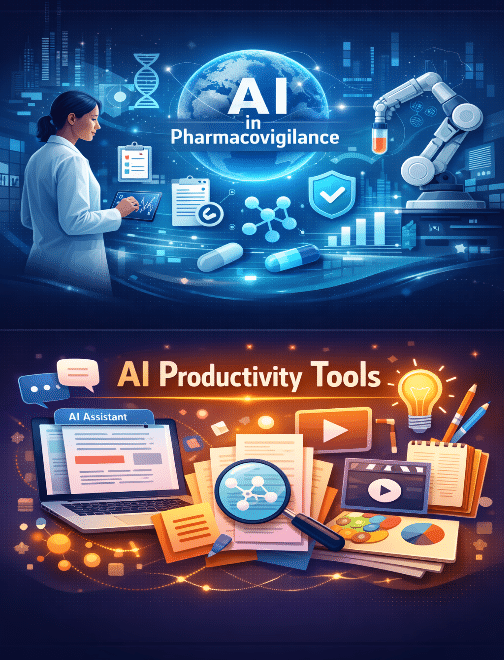
In Part 1, we met the heavy hitter’s tools like GPT, Claude, and Copilot and discovered how they can help us summarize notes, organize thoughts, and tackle complex questions a little faster (and perhaps with one less coffee refill).
But let’s be honest…
Not every challenge in pharmacovigilance is about writing narratives or analyzing safety information.
Sometimes the real struggle is:
- Staring with a blank page wondering how to craft an email.
- Searching through twenty folders trying to find that one meeting note.
- Joining a call and realizing nobody remembers who volunteered for what.
- Trying to explain a complicated workflow using PowerPoint boxes that somehow end up looking like modern art.
That’s where Part 2 begins.
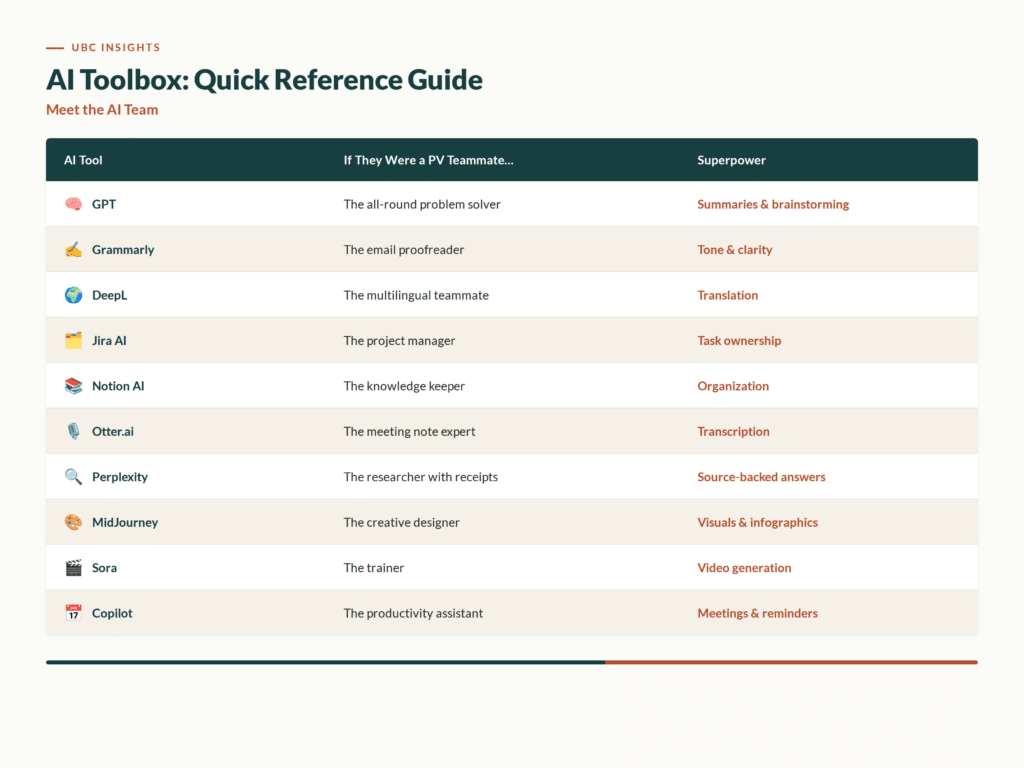
Before we dive into the examples, it’s worth noting that not every AI tool is designed to do everything. Beyond the large language models we explored in Part 1, there is an entire ecosystem of more specialized AI tools. Think of these as niche teammates, each built to help with a specific task, whether that’s writing, organizing information, visualizing processes, researching, or collaborating more effectively.
Because AI isn’t just one giant brain. It’s more like building a team.
Not the team signing the final reports, of course those responsibilities remain firmly within validated systems and established PV processes but the support crew working quietly behind the scenes, helping everyone prepare, communicate, organize, and collaborate more effectively.
So, grab another coffee, and let’s meet some new teammates.
A. The Writers of the Team
- Jasper AI – The Colleague Who Helps You Find the Right Words
We’ve all experienced that moment. You know exactly what you want to say……but somehow the words refuse to come to mind.
Whether you’re preparing:
- A patient awareness article
- Internal communications around a newly approved product
- Educational content for colleagues
Jasper AI helps turn ideas into clear, structured drafts. Think of Jasper as that teammate who says:
“I know what you’re trying to say…how about this?”
And here’s the impressive part: It can generate content in more than 30 languages.
For global organizations, that means one message can be adapted across regions while keeping the same tone and intent. Of course, Jasper isn’t replacing medical judgment. It’s simply helping you overcome the dreaded blank page.Think draft accelerator, not final author.
- Grammarly – The Friend Who Reads Your Message Before You Send It
Have you ever sent an email and immediately thought: “Hmm…that sounded harsher in writing than it did in my head.” We’ve all been there. Grammarly doesn’t write for you. Instead, it helps you communicate what you already drafted more clearly. In PV, where words matter, that can make a big difference.
Whether it’s:
- A follow-up query to a reporter
- A handover note between shifts
- An explanation for a deviation under review
Grammarly helps ensure the tone remains professional, neutral, and easy to understand. Almost like having that trusted colleague who whispers: “Maybe say it this way…”
B. Breaking Language Barriers
- DeepL – The Multilingual Teammate
Global PV means global languages. And sometimes safety information arrives long before formal translations do. That’s where DeepL can help. Imagine receiving a narrative in another language. Instead of waiting days to understand what might be happening, DeepL provides a quick bridge, supporting:
- Early understanding of non-English narratives
- Initial reviews while formal translations are underway
- Local health authority communications and guidance
No, it doesn’t replace certified and validated translation processes. But it helps teams understand sooner and prepare faster, ensuring regulatory compliance.
In PV terms? Better awareness. Faster readiness.
C. Bringing Order to the Chaos
- Jira AI – Turning “Who Was Supposed to Do That?” Into Answers. Let’s face it.
PV work can occasionally resemble organized chaos.
- Inspections.
- Backlogs.
- CAPAs.
- Deviation follow-ups.
- Fifteen comments inside one ticket.
Jira AI helps bring structure by:
- Clarifying tasks
- Summarizing discussions
- Highlighting ownership
- Making next steps easier to see
Because spending thirty minutes figuring out who owns a task isn’t nearly as fun as actually completing it.
- Notion AI – Giving PV Knowledge a Permanent Home
Ever spent ten minutes searching for a document only to discover it was buried inside a folder called: “Final_Version_Updated_FINAL_v3_ReallyFinal”? We’ve all been victims.
Notion AI helps transform scattered information into:
- Searchable knowledge hubs
- Structured pages
- Meeting summaries
- Action trackers
After a governance meeting, notes can become clear recaps in seconds. Suddenly, information stops living in emails and starts living somewhere everyone can actually find.
A revolutionary concept, really.
D. Capturing What People Actually Said
- Otter.ai – Because Memory Has Its Limits
Important decisions don’t always happen inside documents. Often, they happen during calls. And unfortunately, memories are not always FDA-inspectable.
Otter.ai provides:
- Real-time transcription
- Meeting summaries
- Action items
- Easy reference for colleagues across time zones
No more trying to decipher handwritten notes that looked perfectly readable when you wrote them.
E. The Curious Research Assistant
- Perplexity – Bringing Answers with Receipts
We’ve all done it. Google twenty Tabs. Read fifteen websites. Forget why we opened the first tab. Perplexity simplifies the process by providing concise answers backed by references.
Perfect for:
- Preparing for discussions
- Exploring emerging topics
- Reviewing regulatory guidance
Think of it as that knowledgeable colleague who always says: “Here’s the answer…and here’s where I found it.”
F. When Pictures Explain Better Than Paragraphs
- MidJourney – Making Complex Ideas Easier to See.
Sometimes explaining a process using bullet points just doesn’t work. MidJourney can turn text into visuals that help illustrate:
- Safety ecosystems
- Data flows
- Digital transformation journeys
Perfect for training sessions and presentations. Because occasionally, a picture really is worth a thousand words. (And infinitely better than clipart from 2008.)
- Sora – When Instructions Come to Life
Imagine transforming written instructions into short videos. That’s the promise of Sora. For patient education and training, visual explanations can improve understanding and confidence. After all, seeing something demonstrated is often easier than reading page 47 of a manual.
Clearer education today may help support safer use tomorrow.
G. Making PowerPoint Less Painful
- Canva Magic Studio – Turning Processes into Stories
Let’s be honest. Nobody wakes up excited to read a 25-slide PowerPoint deck filled with text. Canva Magic Studio helps convert complicated information into:
- Infographics
- Training materials
- Workflow diagrams
- Visual onboarding guides
Because understanding a process shouldn’t require a magnifying glass and three cups of coffee.
Final Thoughts. Just like we discovered in Part 1, there is no single “best” AI tool. The magic happens when you choose the right tool for the right job. Some tools help you think. Some help you write. Some help you organize. Some help you visualize.Some simply help you remember what everyone agreed to during that meeting last Tuesday.
And sometimes…
You don’t need a Ferrari to cross the street.
The future of AI in pharmacovigilance isn’t about replacing people. It’s about giving people better tools. So, keep exploring. Stay curious. Ask questions. And perhaps grab one more coffee while you’re at it.
Because this AI journey is only getting started.
AI tools are no longer reserved for technical experts.
When used thoughtfully, they can support clarity, efficiency, and creativity across everyday PV activities. From writing and translation to knowledge management and visual communication, these tools help reduce friction and cognitive load allowing teams to focus on what truly matters: patient safety and regulatory compliance.
Thank you for continuing this AI exploration journey with us.
About UBC
United BioSource LLC (UBC) is the leading provider of evidence development solutions with expertise in uniting evidence and access. UBC helps biopharma mitigate risk, address product hurdles, and demonstrate safety, efficacy, and value under real-world conditions. UBC leads the market in providing integrated, comprehensive clinical, safety, and commercialization services and is uniquely positioned to seamlessly integrate best-in-class services throughout the lifecycle of a product.
About the Author

Poonam Pathak, M.Pharm, Manager, Pharmacovigilance
Poonam Pathak, M.Pharm, MBA, LSSBB, is a seasoned pharmacovigilance leader with over 12 years of experience in global drug and device safety operations. Since joining UBC in 2021, she has led cross-functional teams responsible for end-to-end case processing activities across complex clinical and post-marketing programs, partnering closely with sponsors, CROs, vendors, and global stakeholders to deliver high-quality, compliant safety operations.
With a Master of Pharmacy (M.Pharm) in Pharmacology, an MBA in Strategic Management, and Lean Six Sigma Black Belt certification, Poonam brings a unique blend of scientific expertise, operational leadership, and continuous improvement principles to the evolving field of pharmacovigilance. Her experience spans global safety reporting, regulatory submissions, device safety, Argus systems, vendor management, quality oversight, and multi-study program governance.
Throughout her career, she has successfully led operational transitions, process implementations, and strategic initiatives aimed at enhancing quality, compliance, efficiency, and patient safety. Passionate about innovation, she is particularly interested in leveraging AI, digital transformation, and operational excellence to shape the future of pharmacovigilance.
Poonam remains committed to advancing patient safety through collaboration, continuous learning, and strong partnerships across the healthcare ecosystem.